

Dental Bonding in Westlake, OH
Fix a chipped tooth, close a small gap or cover a stubborn stain with tooth-colored composite, usually in a single visit and often with no numbing at all. A fast, conservative way to a more even smile.
Tooth-colored resin, sculpted by hand to repair and reshape your smile
Dental bonding uses a putty-like, tooth-colored composite resin to change the shape, size or color of a tooth. Your dentist applies the material directly to the tooth, sculpts it into place, hardens it with a curing light and polishes it to blend with your natural enamel.
Because bonding adds material rather than removing it, most cases need little or no drilling. That makes it one of the most conservative cosmetic treatments available, and in many situations it is reversible or easy to update later.
At Westlake Dental Associates, we use bonding for chipped and broken edges, small gaps, uneven lengths and discolored spots. It is also a smart first step for patients who want to see a change today and consider porcelain veneers down the road. See how bonding fits with our other dental services and the modern dental technology in our office.
Six common problems dental bonding solves
Bonding works best for small to moderate cosmetic changes, especially on front teeth where appearance matters most and biting forces are lighter.
Chipped or Broken Edges
Rebuilds a chipped corner or broken edge so the tooth looks whole again. One of the fastest cosmetic repairs we do.
Chipped Tooth Repair →Small Gaps Between Teeth
Adds width to neighboring teeth to close small spaces, including a gap between the two front teeth, without orthodontics.
Larger Gaps: Invisalign →Discoloration & Spots
Covers stains, white spots and dark areas that whitening cannot lift, blending the tooth with its neighbors.
Teeth Whitening →Minor Cracks & Worn Spots
Seals small surface cracks and rough, worn areas to smooth the tooth and protect it from further wear.
Worn From Grinding? →Short or Uneven Teeth
Lengthens a short tooth or evens out a jagged smile line so your teeth look balanced when you smile.
Smile Makeover →Composite Veneers
Bonding applied across the entire front surface of a tooth. A same-visit alternative to porcelain for a more uniform look.
Porcelain Veneers →How dental bonding is done, start to finish
Bonding is an in-office procedure that usually takes 30 to 60 minutes per tooth. Anesthesia is typically only needed when bonding is repairing decay or the area is close to the nerve.
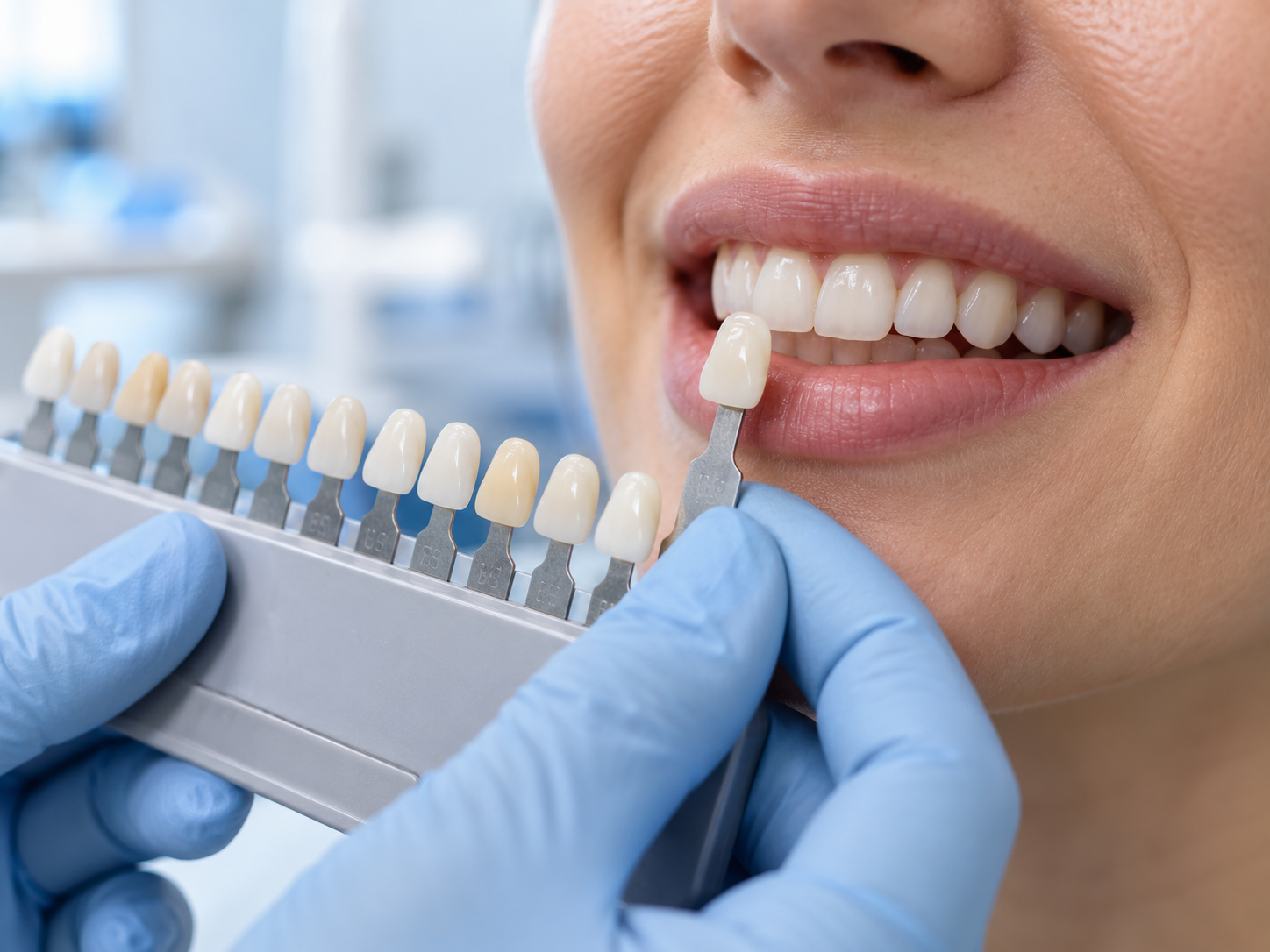
Choose the Shade
A shade guide is used to pick the composite color that blends with your natural teeth.
Condition the Surface
The tooth is lightly roughened and treated with a conditioning liquid so the resin can grip.
Apply & Shape
The putty-like resin is layered on, molded and smoothed into the ideal shape by hand.
Cure the Resin
A special curing light hardens each layer and bonds it firmly to the tooth.
Trim & Polish
Final adjustments and polishing give the bonded area a natural sheen that matches enamel.
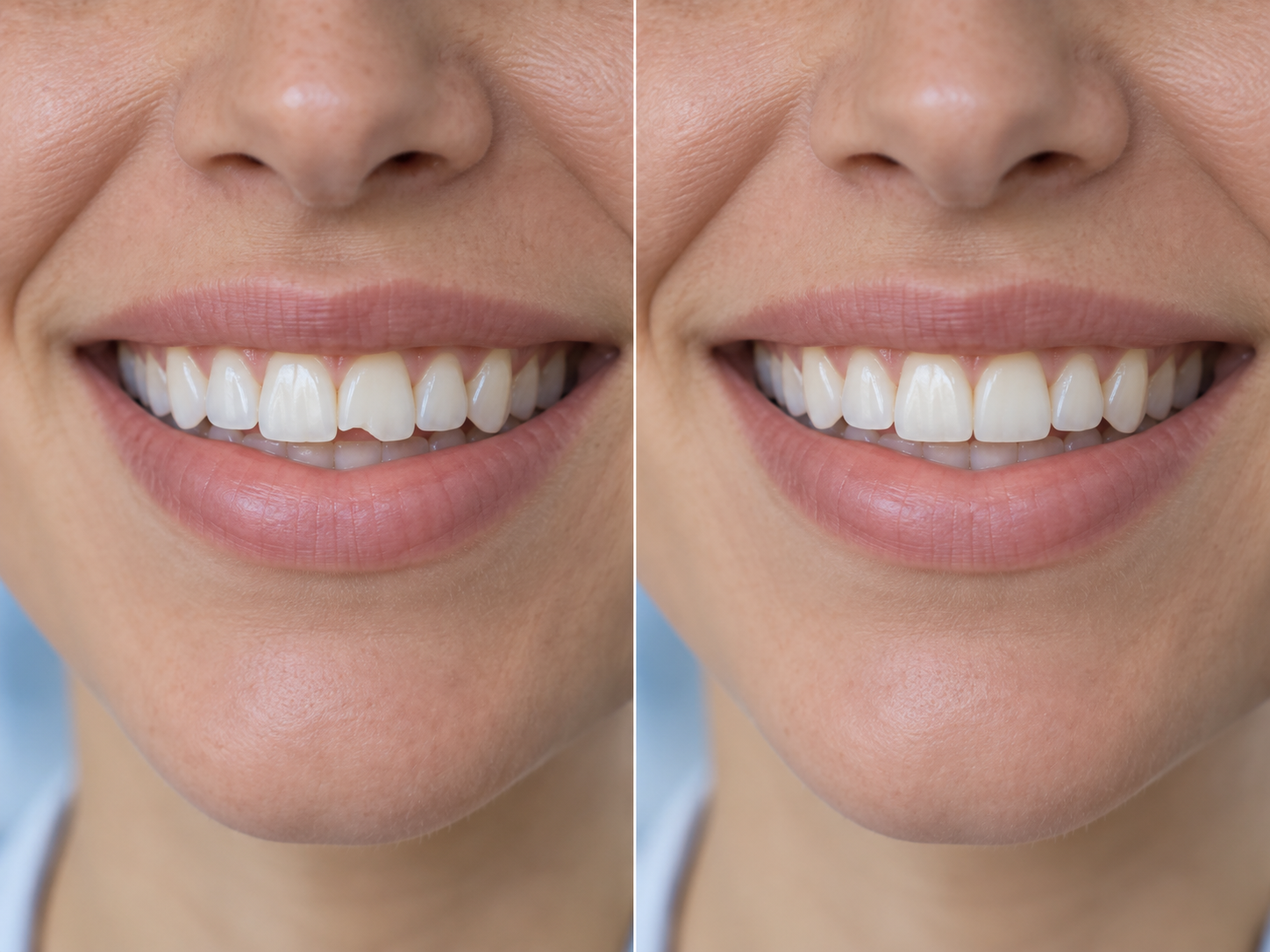
Can bonding fix your chipped tooth, or do you need a crown?
A chipped front tooth is the most common reason people ask about bonding. Whether bonding is the right repair depends on how much of the tooth is missing and whether the inner layers are affected.
Bonding is often a good fit
- Small to moderate chips
- Front teeth with lighter bite forces
- No pain or sensitivity
- Healthy tooth underneath
A crown may be better
- A large part of the tooth broke off
- Back teeth under heavy chewing
- Pain, sensitivity or a visible crack line
- A tooth weakened by a large old filling
If a break is causing pain or exposed a sharp or dark area, treat it as urgent. Call us and we will work to see you the same day.
Dental bonding vs. porcelain veneers
Two ways to improve the look of front teeth. This side-by-side shows how they compare on time, durability and enamel.

Click image to enlarge
Bonding, porcelain veneers or a crown?
All three can improve how a tooth looks. They differ in how much tooth is changed, how long they last and how many visits they take.
| Dental Bonding | Porcelain Veneers | Dental Crown | |
|---|---|---|---|
| Best For | Small chips, gaps, spots and shape tweaks | Changing color and shape of several front teeth | Restoring a broken, weak or heavily filled tooth |
| Enamel Removed | Little to none | A thin layer from the front surface | Tooth is reshaped on all sides |
| Visits | Usually one | Usually two or more | One with CEREC, or two with a lab |
| Typical Lifespan | About 3 to 10 years before touch-up | About 10 to 20 years | Many years with good care |
| Stain Resistance | Can pick up stains over time | Highly stain resistant | Highly stain resistant (ceramic) |
| Reversible? | Often, yes | No | No |
Lifespans vary with bite, habits and home care. Your dentist will recommend the option that fits your tooth and goals.
How to make your bonding last
Composite is durable but not as hard or stain resistant as natural enamel or porcelain. A few simple habits keep it looking fresh.
Brush and floss daily
Brush twice a day with a soft brush and floss once a day to keep edges clean.
Keep regular cleanings
Professional polishing and checkups catch small chips before they grow.
Biting hard objects
Skip nail biting, chewing pens or ice, and opening packages with your teeth.
Heavy staining drinks
Coffee, tea and red wine can tint composite. Rinse with water after.
Dental Bonding FAQs
Dental bonding typically lasts about 3 to 10 years before it needs a touch-up or replacement. How long yours lasts depends on where the tooth is, how hard you bite, and habits like grinding, nail biting or chewing ice. Regular cleanings and checkups help us polish and repair small wear before it becomes noticeable.
Most people feel little or no discomfort. Cosmetic bonding usually does not require numbing because the resin is added to the surface of the tooth rather than drilling into it. Anesthesia may be used if bonding is repairing decay, if the chip is close to the nerve, or if you prefer it.
For a small or moderate chip on a single tooth, bonding is usually the faster, more conservative choice: one visit and little or no enamel removed. Porcelain veneers are often a better fit when you want to change the color and shape of several teeth, or want a more stain-resistant, longer-lasting result.
No. Whitening gels lighten natural enamel but do not change the color of composite resin. If you want a brighter smile, we recommend whitening first, waiting for the shade to settle, and then matching the bonding to your new color.
Composite resin is more porous than porcelain, so it can pick up stains over time from coffee, tea, red wine and tobacco. Rinsing with water after dark drinks, brushing regularly and keeping up with professional cleanings help it stay bright. Surface stains can often be polished away at your checkup.
Bonding is one of the most conservative cosmetic treatments. The tooth surface is lightly roughened so the resin can grip, but little or no enamel is removed. That is why bonding can often be removed or updated later, unlike porcelain veneers or crowns.
Yes. The resin is fully hardened with a curing light before you leave, so you can eat right away. For the first day or two, some patients avoid dark, staining foods and drinks as an extra precaution. Long term, avoid biting directly into very hard items with bonded front teeth.
Every case is unique, so contact us for a personalized quote. Cost depends on how many teeth are treated and how much material each one needs. When bonding repairs damage rather than a purely cosmetic concern, insurance may help. Our team reviews your benefits, and our financial options page explains payment choices.
A more even smile can take less than an hour
Chipped, gapped or uneven teeth are often fixed in a single visit at our Westlake office on Center Ridge Road. Call us or book online to see if bonding is right for you.

Comprehensive Family Care
The tradition of family is central to every visit at Westlake Dental. Our goal is to treat patients with the same care and compassion we would our own families. As general dentists who do not believe in one-size-fits-all care, Drs. Constantinou, Reichard, and McClendon consult with each patient, from children through adults, to provide comprehensive treatment solutions unique to each person.
3-D Guided Implants
When it comes to dental implants, accuracy is everything. With the latest 3-D imaging, implants at Westlake Dental are taken to a new level of precision. Dr. Constantinou has traveled the country to study at some of the foremost implant facilities in the world in order to understand the wave of innovation and advancement in the field. Drs. Reichard and McClendon are also trained in the latest technology and methods..
Same-Day Crowns
With Westlake Dental Associates’ state-of-the-art CEREC machine, patients can receive beautiful crowns, often during just one appointment, instead of waiting weeks to get their crowns back from the lab. Teeth are quickly restored without any messy impressions, which means a lower cost and better results than with traditional treatment.
