
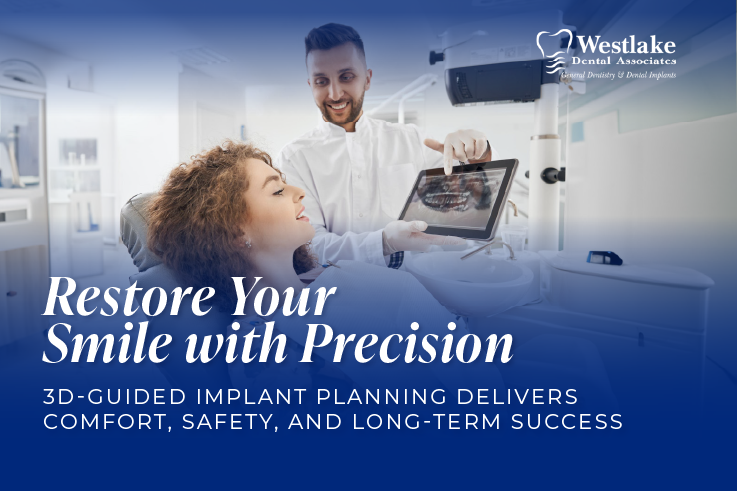
How Advanced Imaging and Digital Planning Are Transforming Implant Dentistry in Westlake
Dental implants have long been considered the gold standard for replacing missing teeth—but today’s technology has taken implant dentistry to an entirely new level.
At Westlake Dental Associates, we use 3D‑guided implant technology to plan and place implants with exceptional accuracy. This modern approach allows for safer procedures, faster healing, and more predictable long‑term results.
If you’re considering dental implants, here’s why the technology behind them matters more than ever.
What Are 3D‑Guided Dental Implants?
3D‑guided dental implants use advanced digital imaging—typically cone beam computed tomography (CBCT)—to create a detailed three‑dimensional view of your jaw, teeth, nerves, and bone structure.
This data allows your dentist to:
- Plan the exact implant position before surgery
- Avoid nerves and sinus cavities
- Determine ideal implant depth and angle
- Design a custom surgical guide for precise placement
Instead of relying on estimates, implant placement is mapped out digitally before the procedure even begins.

Why Precision Matters in Implant Dentistry
HDental implants are more than just replacing a tooth—they integrate directly with your jawbone. Precision during placement is critical for:
- Long‑term stability
- Healthy bone integration (osseointegration)
- Proper bite alignment
- Natural-looking aesthetics
Even small placement variations can affect comfort, appearance, and durability. That’s where 3D guidance makes a major difference.
Key Benefits of 3D‑Guided Implants
Treatment depends on severity, but may include:Patients at Westlake Dental Associates benefit from this technology in several important ways:
- Higher Accuracy: Digitally planned placement minimizes guesswork
- Minimally Invasive Surgery: Smaller incisions often mean less discomfort
- Faster Healing: Reduced trauma supports quicker recovery
- Improved Safety: Sensitive structures like nerves are clearly identified
- Predictable Results: What we plan is what we place
This level of control leads to better outcomes—and greater peace of mind for patients.
What Conditions Can 3D‑Guided Implants Treat?
You should schedule an evaluation if you experience:3D‑guided implants are ideal for patients who need:
- Single tooth replacement
- Multiple missing teeth
- Implant‑supported bridges
- Full‑arch restorations
They’re especially valuable for patients with limited bone, previous tooth loss, or complex anatomy.
The Implant Process at Westlake Dental Associates
Here’s what you can expect:
- Comprehensive Consultation & 3D Imaging
We evaluate your oral health and capture detailed digital scans. - Digital Treatment Planning
Implant placement is planned virtually for optimal positioning and safety. - Guided Implant Placement
A custom surgical guide ensures precise execution of the plan. - Healing & Restoration
After integration, a custom crown or restoration is placed for a natural finish.
Throughout the process, our focus is comfort, clarity, and long‑term success.
Is 3D‑Guided Implant Dentistry Right for You?
You may be a great candidate if you:
- Are missing one or more teeth
- Want a permanent, fixed solution
- Prefer advanced, minimally invasive care
- Value precision and long‑term results
Even if you’ve been told implants aren’t an option, modern techniques may open new possibilities.
Advanced Implant Care, Designed Around You
At Westlake Dental Associates, technology isn’t about being flashy—it’s about delivering better care. Our use of 3D‑guided implant planning allows us to restore smiles with confidence, comfort, and predictability.
If you’re considering dental implants in Westlake, we invite you to schedule a consultation and learn how modern implant dentistry can work for you. Call today or book online to take the next step toward a stronger, healthier smile.
FAQs
Yes. Digital planning helps reduce surgical risks and improves placement accuracy.
Often, yes. More precise placement typically means less tissue disruption.
With proper care, implants can last decades—and often a lifetime.
Coverage varies, but we’ll review your benefits and financing options upfront.